Window Frame Fabrication Nepal: Types, Cost & Process Guide
Making window frames is a vital part of the process of creating windows that are long-lasting, secure and weather-tight. A properly constructed frame will keep dust, rain
Summarize With AI
Get a quick summary from your favorite AI model
Table of Content
- 1. Window Frame Fabrication
- 2. Window frame materials can be found in a variety of forms.
- 3. Fabrication of wood window frames.
- 4. Fabrication of aluminium window frames.
- 5. Steel Window Frame Fabrication
- 6. UPVC Window Frame Fabrication
- 7. Aluminium, wood or steel window frames vs UPVC window frames.
- 8. The manufacturing process of window frames.
- 9. 1. Site Measurement
- 10. 2. Design and Specification
- 11. 3. Material Selection
- 12. 4. Cutting and Preparation
- 13. 5. Joining and Assembly
- 14. 6. Surface Finishing
- 15. 7. Hardware and Glass
- 16. 8. Quality Inspection
- 17. 9. Installation
- 18. Window Frame Fabrication Cost in Nepal
- 19. You can get the price of Aluminium 4x4 Windows in Nepal.
- 20. Wood Window Price in Nepal
- 21. UPVC Windows Price in Nepal
- 22. Elements of a window fabrication quotation?
- 23. The best way to select a Window Frame Fabricator
- 24. The most frequent window frame fabrication errors are common, and can be easily identified.
- 25. Window Frame Maintenance
- 26. Professional Tips
- 27. Frequently Asked Questions
Making window frames is a vital part of the process of creating windows that are long-lasting, secure and weather-tight. A properly constructed frame will keep dust, rain and cold air out, and it will keep the glass and hardware in place. Appropriate fabrication and installation is particularly critical for houses and buildings in Kathmandu, Lalitpur, Bhaktapur and Pokhara in Nepal.
This guide explains the materials used in window frames, how the frames are fabricated, installation, cost considerations and how to select a window frame fabrication company in Nepal.
Window Frame Fabrication
Window fabrication is the more general term for the process of creating a complete window unit, whereas window frame fabrication is the process of creating the structure that contains the sash, glass, and hardware.
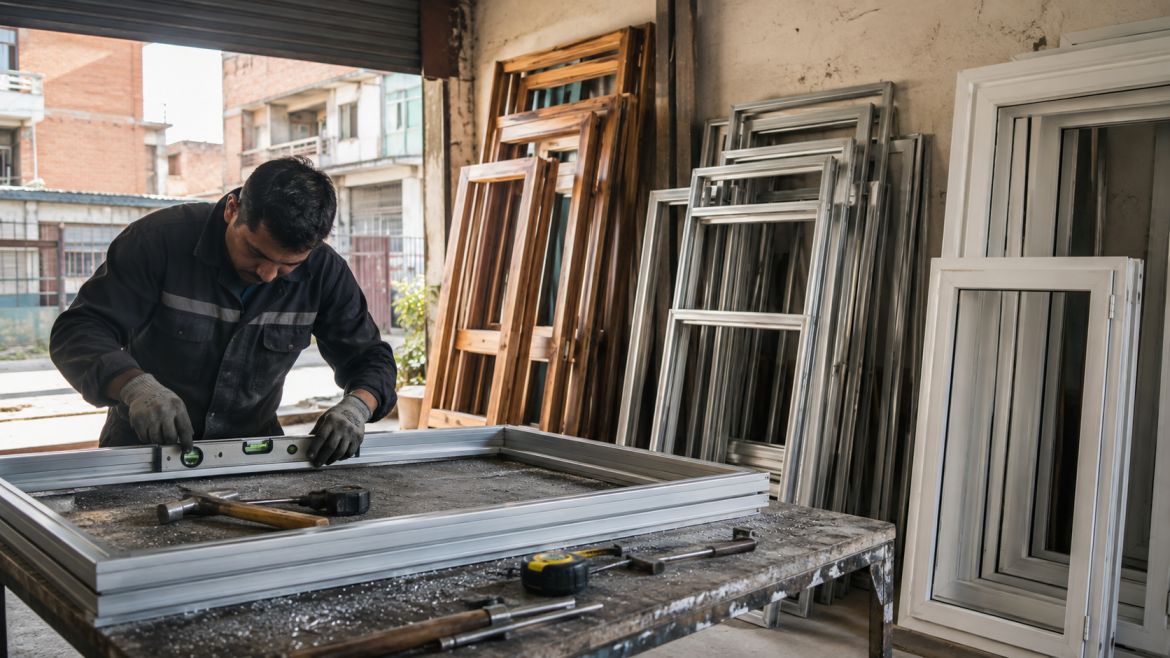
There are a few key components for a typical window frame. The outer frame is secured to the wall opening. The part which holds the glass and moves or stays still is the sash. Larger windows are divided into sections by mullions and transoms. Gaps are filled with weatherstripping and gaskets to prevent air and water leakage. The window may be open, closed and locked with hinges, handles, locks and rollers.
It helps you to distinguish between fabrication and installation. Fabrication takes place in a workshop or factory, where raw material like timber, aluminium profile, steel section or UPVC profile is cut, connected and finished to produce an existing window unit. Installation is done on site and the finished unit is installed in the wall opening, aligned, and sealed. Even though a fabricator does a great job in the shop, if the installation work is not done properly, there will be leaks or misalignments in the window. The first and second stages must be carried out correctly to achieve good results. If you are working with older frames rather than new construction, this same distinction is worth keeping in mind when you look into window and door replacement as well.
Window frame materials can be found in a variety of forms.
In Nepal, window frames are mostly constructed using four materials, namely wood, aluminium, steel and UPVC. In the years of use, each one has different properties when exposed to sun, rain and dust and depends on your building type, budget and location.
Fabrication of wood window frames.
Wood is still the material used in the traditional houses of Nepal, and is used in the older homes of the Newari style as well as in newer homes.
The initial phase of wood window frame manufacturing involves choosing seasoned wood. The first year or two after cutting is a critical period for warping and cracking of unseasoned or poorly seasoned wood, so seasoning is a major control point for the fabricator. Sal, sisau (rosewood) and different pine varieties are commonly used in Nepal; sal being preferred for durability as it is more costly.
After wood is chosen, it is cut to the required dimensions and joined by mortise and tenon or other traditional joinery and then sanded and finished with polish, varnish, or paint. The beading and grooving is done to secure the glass and hardware is added as a final step.
Wood is a classic choice that still looks nice, and is quite customizable for carved or traditional designs. However, there is also a level of intrusiveness that must be faced with wood, such as needing repolishing after a few years and being highly susceptible to termites and moisture if not handled properly - a serious issue during Nepal's long monsoon season. Traditional style homes, interiors that do not have to be low maintenance, and heritage style buildings are places where wood windows are common. If you are unsure which look or material fits your home, an interior design consultation can help you decide before you commit to a design.
The critical factors affecting the wood window price in Nepal are the kind of wood, quality and seasoning, the size and design of the frame, type of joinery, glass specification, the quality of hardware, and the finish applied. A simple window of sal wood will be significantly cheaper than an intricately carved window of the same wood.
Fabrication of aluminium window frames.
The use of aluminium has grown as the preferred material for the construction of new buildings in Kathmandu Valley and other urbanized parts of Nepal for the following reasons:
The first step in the process of aluminium window frame fabrication is the selection of the profile the aluminium section that is extruded to create the frame and sash. Profiles are cut to the specified angles (usually 45 degrees at the corners) and then connected by corner crimping, screws or welding (as appropriate to the system). Raw aluminium can become dull over time as it oxidises and is treated with powder coating or anodising for colour and to inhibit corrosion. Glass is then placed in with rubber gasket or silicone sealant and hardware fitting components like friction hinges, handles and locks are added.
The aluminium frames are light in weight, extremely durable, totally termite and rot proof and easy to maintain, aside from regular cleaning. They also provide the possibility of using a slim frame profile, providing even more glass area and natural light. The disadvantages include the fact that when aluminium is used, heat and cold transfer is greater than wood or UPVC (unless a thermal break profile is used to achieve this) and lower quality coatings will fade and peel over time. This is often the material of choice for new house construction projects across Kathmandu Valley, where builders want a modern look without heavy upkeep.
Aluminium window price in Nepal depends on the profile brand and thickness, window size, type of glass in windows (clear glass, tinted glass, double glass), the quality of hardware, powder coating, anodizing finish, window design (sliding windows or casement windows) and installation requirements.
Steel Window Frame Fabrication
Steel window frames are less common in modern homes in Nepal but are still used in older, industrial, institutional, and security-focused buildings. They are typically made from mild steel or box sections, which are cut to size and welded for strong, durable joints. The welds are then ground, cleaned, primed, and painted or powder-coated to protect against rust.
Steel offers excellent strength, security, and support for larger glass panes. However, corrosion is its main drawback, especially during Nepal’s humid monsoon season. Regular inspection and repainting can help prevent rust and extend the frame’s lifespan.
UPVC Window Frame Fabrication
UPVC window frames are becoming increasingly popular in Nepal, especially in homes and apartments near busy roads. They are made from hollow, multi-chambered profiles that are cut and welded at the corners to create a tight seal. Steel or aluminium reinforcement may be added for extra strength, followed by glass, gaskets, and hardware installation.
UPVC offers good sound insulation, thermal performance, and low maintenance. It does not rust, rot, or require painting and is also resistant to moisture and termites. However, it offers fewer design and colour options than wood or aluminium and may require reinforcement for larger openings.
The cost of UPVC windows in Nepal depends on factors such as profile quality, chamber design, window size, glazing type, opening style, hardware, and installation complexity.
Aluminium, wood or steel window frames vs UPVC window frames.
|
Feature |
Wood |
Aluminium |
Steel |
UPVC |
|
Initial cost |
Moderate to high |
Moderate |
Moderate to high |
Moderate to high |
|
Durability |
Good with maintenance |
Very good |
Excellent structurally |
Good |
|
Maintenance |
Middle (polish, pest checks)Low (polish, pest checks) |
Low |
Moderate (rust checks) |
Very low |
|
Appearance |
Warm, traditional |
Modern, sleek |
Industrial, sturdy |
Clean, minimal |
|
Customization |
High |
Moderate to high |
Moderate |
Lower |
|
Weather resistance |
Needs treatment |
Excellent |
Excellent at cleaning/caring for the coating |
Excellent |
|
Typical use |
Traditional homes, interiors |
Apartments, new builds |
Security grilles, industrial |
Apartments, noise-sensitive areas |
There is no one size fits all material. A house in the style of the past in Bhaktapur might require wood, a modern apartment tower in Kathmandu is likely to need aluminium or UPVC and a ground floor security window for a warehouse will be best for steel.
The manufacturing process of window frames.
The basic steps of a pro fabrication job are basically the same, regardless of what materials are used.
1. Site Measurement
All work begins with correct measurement of the opening, width, height, squareness, level and plumb of the opening and the surrounding wall condition is checked. Any slight mistake in this step can lead to gaps, uneven operation or problems with frame assembly later on, so this is as important as the fabrication itself.
2. Design and Specification
The fabricator then decides on the window type (fixed, casement or sliding), the direction of opening, the glass specification and the type of hardware. This is also where to choose the features such as single or double glazing and any particular security or ventilation requirements.
3. Material Selection
Depending on the design and budget, a particular material, profile or timber grade is selected. This choice impacts cutting method and finishing time, among other things, that are downstream.
4. Cutting and Preparation
The frame components are cut to fit the measurements and design. The quality of the fit of the joints is directly related to precision in this area.
5. Joining and Assembly
It is a significant step depending on the material. Wood is usually joined together by mechanical means such as mortise and tenon. Aluminium is typically welded by corner crimping or screws. The joints are welded using steel for maximum strength. Heat welding is used with UPVC profiles to get a sealed corner joint.
6. Surface Finishing
Wood is sanded and polished, varnished, or painted. Powder coating or anodizing is used on aluminium. Steel is primed and then painted or powder coated. UPVC is usually delivered pre-finished by the profile manufacturer: laminated finishes can also be found.
7. Hardware and Glass
Handles, hinges (sliding systems), locks and rollers (sliding systems) are installed, as are the glass. Gaskets and sealants seal the assembly to prevent it from getting wet.
8. Quality Inspection
A quality fabricator tests dimensions, alignment and squareness, surface finishing, hardware operation, glass condition and sealing before a unit leaves the workshop. This is one of the more common causes for windows being delivered with issues that could have been detected prior to delivery.
9. Installation
Lastly, the window is installed in the opening in the wall, aligned, fastened, and sealed; any final adjustments are made to ensure the sash opens and closes easily.
Window Frame Fabrication Cost in Nepal
Unfortunately, there is no set price for window frame fabrication and any window frame cost quote that provides a window frame cost without any context is simplifying things. The final quote you are given will be based on various factors including the material type, specific profile/section of timber you are choosing, window size and quantity, design type (fixed, casement and sliding windows), glass type, window hardware quality, surface finish, fabrication complexity, labour and window transportation to site, and the actual window installation.
As there is considerable variation in these factors from project to project it is best to get a site-specific measurement and a detailed quotation for your specific project, avoiding just taking a figure from the web.
You can get the price of Aluminium 4x4 Windows in Nepal.
A "4x4 window" is a 4-foot by 4-foot window opening, which is frequently found in Nepali homes and is a search term used by many. However, the cost of a 4x4 aluminium window may still differ depending on the profile chosen, the type of glass, the window opening method (fixed, sliding or casement), the hardware options selected, the type of finish and the number of windows being ordered. Noticeable differences in the price of two 4x4 windows from different manufacturers, with different window profiles and glass thickness can be observed at the same opening size. Don't take anything on faith always request a written quote according to your specific opening.
Wood Window Price in Nepal
The cost of wood window in Nepal varies with respect to wood type, wood quality and seasoning, frame size, window design or carving, glass specification, hardware, polish/paint finish, labour and installation cost. The cost of sal wood is higher than other softer options as it is dense and durable, and intricate traditional designs require longer to produce as well.
UPVC Windows Price in Nepal
The price of UPVC windows in Nepal depends on the quality and chamber design of the UPVC profile, window size, the type of glass (single or double), the window opening system selected, the type of hardware used, and the complexity of the installation. Multi-chamber profiles are more expensive than simpler profiles and have better long-term insulation and rigidity, but are better in this regard.
Elements of a window fabrication quotation?
A good quote should enable you to see more than just the price. When considering a quote, ensure that it includes the following:
-
Material
-
To specify the type of profile or section. To define a type of profile or section.
-
Exact dimensions
-
Quantity of windows
-
Glass specification
-
Hardware details
-
Put to an end (color, coating or polish)
-
Fabrication charges
-
Installation charges
-
Transportation
-
Sealants and accessories
-
Warranty terms
-
Timeline for completion
-
Payment terms
-
Applicable taxes
When looking at an accurate quotation, you will be able to avoid any surprises later. A lower price without installation or quality hardware or glass specifications can be more expensive when the missing components are added.
The best way to select a Window Frame Fabricator
There are a few things that can be done to prevent a disastrous result. Check the fabricator's portfolio and request to view past work, preferably work of a similar nature to yours. Ensure they are clear in their materials and profiles and not using vague terms. Inquire about their methods of measurement and if they go to the site. If possible, inspect sample work to assess the quality of the fabrication including the appearance of the joints and finish. Make sure that installation is done by someone else a superb fabrication team with a careless installation crew can still yield a substandard outcome. When asking for information about the hardware, inquire about the brand, warranty, and after-sales support in case there are any issues that require fixing down the road.
When looking for frame fabrication near me, look for fabricators that provide full written quotes instead of an estimate, and explain the process. A local presence also allows for site visits, adjustments and after-sales support to be much easier to arrange.
The most frequent window frame fabrication errors are common, and can be easily identified.
There are some common pitfalls that can lead to issues and understanding them can help you ask the right questions before work commences.
Poor window frame fabrication can cause gaps, misalignment, water leakage, drafts, weak joints, and early damage. Low-quality materials, poor finishing, faulty hardware, incorrect glass fitting, and improper installation can further reduce the window’s lifespan. Always check measurements, material quality, workmanship, and installation before accepting the finished work.
Window Frame Maintenance
Each material has different maintenance requirements and being aware of what to expect will help you plan accordingly.
Wood frames have to be repolished or repainted periodically, regularly inspect for termites or wood rot and repair any cracked or peeling surface finish promptly, particularly before the monsoons. Aluminium frames should be cleaned periodically to get rid of dust and dirt, gasket condition should be checked periodically, and if hinges or rollers begin to get stiff, lubricate them. To prevent corrosion of steel frames, they must be inspected for rust regularly, especially at joints, and repainted as necessary. There is very little to do with UPVC frames other than the normal cleaning, except to periodically inspect gaskets and hardware for wear to identify it early. Booking a pre-monsoon building check before the rains arrive is a good way to catch frame and seal issues while they are still minor.
In all materials, inspect for signs that repairs are required or that the materials need to be replaced, including problems opening or closing, gaps or leaks around materials, cracked or foggy glass or hardware that is not closing properly.
Professional Tips
When ordering, always take a measurement of the opening before you buy, not by guesswork or from old drawings even minor changes in structure in an old house can alter actual dimensions. Before placing a large order, inspect a sample joint or finished corner for quality it gives you valuable insight into the fabricator's quality control. In the monsoon months of the Kathmandu Valley, special emphasis should be placed on sealing and drainage around the frame as a standing water at the sill is a frequent source of long-term damage. When remodeling an existing structure, allow time to have a wall opening inspected and repaired, if necessary, before the new frame is installed; a new window is not likely to fit into an improperly cut opening in an old wall.
Frequently Asked Questions
1. So, what is window frame fabrication?
It refers to the creation of a window frame, which involves measuring, cutting, joining, finishing and installing glass and hardware into a window opening before the frame is installed.
2. So, what is window fabrication?
Window Fabrication is a general term describing the manufacturing process for a window assembly, including the frame and glass sash which hold the glass.
3. What is the cost of window frame making in Nepal?
Cost varies according to material, size, design, glass, hardware and installation. The only way to be sure of an actual cost is to make a site visit and receive a detailed quotation.
4. What is the cost of aluminium window in Nepal?
This depends on the profile, window size, window glass, hardware and window finish that is selected. Request a quote if you have a particular opening to obtain an accurate quote.
5. What is the price of 4×4 aluminium window in Nepal?
The 4x4 window size is about 4 feet by 4 feet, but the exact size will depend upon the profile, glass, hardware and window opening style, so it is best to get a written quotation to confirm the exact size.
6. How much does wood window cost in Nepal?
This will depend on the species of wood, quality, seasoning, design and finish. More dense woods, such as sal, typically will be more expensive than less dense woods.
7. How much does UPVC window cost in Nepal?
UPVC Price is based on profile quality, chamber design, glass specification, opening style and hardware brand.
8. What's the best window frame material?
No one material is the best. Traditional and interior use wood suits; modern home and office construction aluminium suits; noise-sensitive, low maintenance or security applications UPVC suits; steel suits.
9. What is the time to fabricate window frame?
The turnaround time is dependent on the type of materials, design complexity and quantity so please contact your fabricator for an estimated turnaround.
10. How is aluminium window frame made?
Aluminium profiles are cut to length, joined at the corners using crimping, screws or welding (depending on the system), powder coated or anodized and finally fitted with glass and hardware.
Community
Likes and comments
Like the post if it helped you, and leave a comment to share your experience. Every comment is reviewed by our admin team before it appears publicly.
Want to join the conversation?
Sign in to leave a comment. Every comment is reviewed by our admin team before it becomes public.
Log in to commentApproved comments
Showing the latest approved conversation for this post.
No approved comments yet
Be the first to start a conversation once your comment is approved.