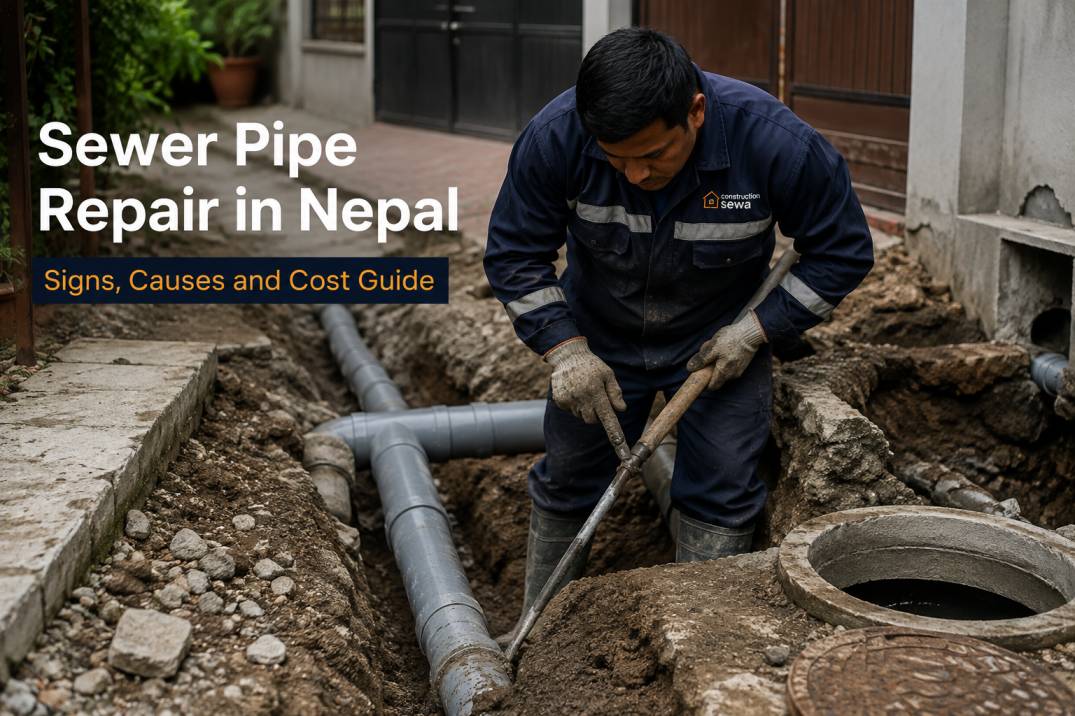
Sewer Pipe Repair in Nepal: Signs, Causes and Cost Guide
A toilet that gurgles every time the kitchen sink drains. A patch of the courtyard that stays damp long after the last rain. A drain that clears itself after a plunger, t
Summarize With AI
Get a quick summary from your favorite AI model
Table of Content
- 1. The Warning Signs Worth Taking Seriously
- 2. More Than One Drain Acting Up at the Same Time
- 3. The Same Clog Coming Back Within Weeks
- 4. A Smell That Doesn't Go Away After Cleaning
- 5. Damp Ground, Sinking Soil or Unexplained Cracks Along the Pipe Route
- 6. Why Sewer Lines Fail in Kathmandu Valley Homes
- 7. Repair or Replace? What the Professional Tells the Parent or Guardians
- 8. Sewer Pipe Repair Methods Used in Nepal
- 9. Pipes and Pipes to Be Repaired
- 10. The Rate of Sewer Pipe Repair in Kathmandu Valley
- 11. Municipal Line or Your Own Pipe? Knowing Who to Call
- 12. Selecting a Sewer Pipe Repair Contractor
- 13. Preventing the Next Backup
- 14. The Right Way to Get It Fixed
A toilet that gurgles every time the kitchen sink drains. A patch of the courtyard that stays damp long after the last rain. A drain that clears itself after a plunger, then clogs again three weeks later at the exact same spot. None of these look like an emergency on their own, which is exactly why so many homeowners in Kathmandu Valley wait months before calling anyone. By the time they do, what started as a minor pipe defect has turned into a full excavation job.
Sewer pipe repair rarely announces itself the way a burst tap does. The pipe carrying wastewater away from a home usually runs underground or under a floor slab, so damage builds quietly until the symptoms show up somewhere inconvenient. This guide covers what those symptoms actually mean, why sewer lines fail across Kathmandu, Lalitpur and Bhaktapur, what a proper repair involves, and roughly what it costs, so you can tell a routine clog from a problem that needs a plumber with a shovel.
The Warning Signs Worth Taking Seriously
Most people only think about their sewer line on the day it stops working completely. A handful of signs usually show up first, often weeks or months before a full backup.
More Than One Drain Acting Up at the Same Time
A single slow sink is usually just that sink, a bit of hair or soap scum sitting in the trap. It's a different story when the kitchen sink gurgles as the toilet flushes, or the bathroom floor drain backs up whenever the washing machine empties. All of a home's drains eventually feed into one main line, so when several fixtures act up together, particularly the lowest ones in the house, the blockage or damage usually sits further down the shared pipe rather than in any single fixture.
The Same Clog Coming Back Within Weeks
A clog that clears with a plunger or a bottle of drain cleaner and then returns in the same spot a month later isn't really being fixed each time, it's being pushed past a narrow point that keeps trapping debris again. That narrow point is often a sagging section of pipe, a partial crack, or a joint that has shifted out of alignment. Repeated clogs at one location are one of the clearer signs that the problem is structural rather than just something stuck in the line.
A Smell That Doesn't Go Away After Cleaning
Every drain has a water seal (the trap) that's supposed to block sewer gas from coming back up into the house. If a bathroom or kitchen still smells faintly of sewage after a thorough cleaning, and especially if that smell is stronger near a floor drain or an inspection chamber, it usually points to a broken seal, a cracked pipe venting gas into the surrounding soil, or a vent pipe that isn't doing its job. Odour on its own doesn't confirm a broken pipe, but combined with any of the other signs here, it's worth a proper look.
Damp Ground, Sinking Soil or Unexplained Cracks Along the Pipe Route
Outdoors, a sewage or drainage leak underground often shows up as a patch of ground that stays wet without rain, a slight dip or soft spot in the courtyard, or grass that looks noticeably greener over a specific line. Indoors, hairline cracks appearing along a wall near a bathroom or kitchen, especially on a ground floor, can sometimes trace back to soil movement caused by a leaking line underneath. These are the signs people notice last, usually because the leak has already been running for a while by the time it reaches the surface.
Why Sewer Lines Fail in Kathmandu Valley Homes
A few causes come up again and again once a drainage line is actually opened up and inspected.
· Old pipe sections still in the ground: Many older homes in central Kathmandu, Patan and Bhaktapur still have short runs of galvanised iron, cast iron or unlined clay pipe from an earlier renovation or the original construction, tucked in among newer PVC sections. These older materials corrode, crack, and lose their internal diameter with age far faster than modern uPVC or HDPE.
· Incorrect slope from the original installation: A sewage or drainage pipe needs a specific, consistent fall to keep solids moving. Where plumbing was laid without proper planning, often during quick renovation work without an engineer involved, the pipe ends up with a flat or uneven stretch. Waste settles instead of flowing, and that section clogs again and again no matter how often it's cleared.
· Ground settlement: Kathmandu Valley sits on soft, sediment-heavy soil left behind by an ancient lakebed, and that ground shifts and compacts gradually over the years, more so on filled or reclaimed plots. Buried pipes can sag or go slightly out of alignment as the soil beneath them settles unevenly, creating a low spot ("belly") where waste collects instead of draining away.
· Monsoon overload: The monsoon in Nepal usually starts around the middle of June and ends in early October, and older or undersized drainage lines that cope fine the rest of the year can get overwhelmed once heavy, sustained rainfall adds stormwater and silt into the mix. A line that's already narrowed by root growth, scale, or a partial crack is far more likely to back up during these months.
· Grease, construction debris and non-flushable material: Kitchen grease that solidifies inside the pipe, leftover cement or plaster washed down during renovation work, and wipes or sanitary material flushed into toilets are common, avoidable causes of recurring blockages that eventually damage the pipe itself.
· Root intrusion: Less dominant here than in leafier suburban markets abroad, but not absent, especially in older bungalow-style compounds in Lalitpur and Bhaktapur with mature trees close to the drainage route. Roots exploit existing cracks or loose joints rather than causing the initial damage themselves.
Repair or Replace? What the Professional Tells the Parent or Guardians
Before any digging starts, a competent plumber needs to work out where the fault actually is and how bad it is. For most residential jobs in Nepal, that means manually snaking the line to feel for resistance or blockage points, checking the slope and condition at accessible inspection chambers and manholes, and, where the location still isn't obvious, opening a test section at the suspected point. Camera inspection equipment exists and gets used on harder-to-diagnose commercial jobs, but for a typical home repair, a plumber who knows how to read what a snake, a chamber, and the pattern of symptoms are telling them can usually pinpoint the problem without it.
Once the location and cause are clear, the decision comes down to two options:
· Point repair (spot repair): Digging up and replacing only the damaged area, suitable where the length is collapsed, a bad joint or single crack, and the remainder of the line is in reasonable condition.
· Full line replacement: If the pipe is so old that there are several more points of failure in the same line, if the original slope requires correction or if the entire line is failing, it is a worthwhile replacement.
Repairing a 15-year-old clay pipe at one location and then having it break again a few feet away a year later costs more than proper installation of the pipe the first time. A simple site evaluation can typically let you know what situation you're in.
Sewer Pipe Repair Methods Used in Nepal
The usual and practical solution for the majority of properties in the Kathmandu Valley is open-cut excavation and pipe replacement. The affected section (or the entire run) is exposed, the damaged pipe is taken out and new pipe is installed at the proper slope, bedded and surface restored before backfilling. It's more disruptive than the alternatives, but it's reliable, well understood in the community and doesn't require specialized equipment that may be difficult to source or maintain in Nepal.
Although not a common practice in the local market, trenchless repair options like pipe relining or pipe bursting should be known about. These methods involve rehabilitating a pipe from the inside with little or no digging, and are used in markets where trenchless equipment supply chains are well-established. If a contractor is available in Nepal to offer trenchless solutions, ask the contractor directly about the equipment they use and how many similar jobs have actually been successfully completed; there is a reason that open excavation is the preferred option in Nepal—it is due to the condition of the soils, the access and the equipment.
The working sequence for sewage and drainage line work is more or less consistent, depending on the method you use – consultation, site inspection, inspection to establish cause and extent of damage, planning the route of pipe and its slope, itemised quotation, excavation and pipe laying, leak and flow test prior to covering over, and backfilling and surface restoration.
Pipes and Pipes to Be Repaired
Each of the three materials which are commonly used for the repair work of sewage and drainage are applicable to a slightly different situation in Nepal:
· PVC, an economical, readily available material that is suitable for ordinary domestic sanitary system loads.
· uPVC, which is more rigid and impact resistant, is usually the better option where sewer lines are regularly used or in commercial buildings.
· HDPE, flexible and corrosion resistant, is well suited for larger diameter runs, deeper underground sections and soil change.
Whichever material is used, it's advisable to check if the pipe has been certified by Nepal Standard (NS) mark by the Nepal Bureau of Standards and Metrology. It's a quick and easy way to ensure that what is being put into the ground has been tested and not just taken on faith by the supplier.
The Rate of Sewer Pipe Repair in Kathmandu Valley
The actual cost of sewer pipe repair depends on the results of a site visit, variables such as the depth and location of the pipe, if it's a single point or a line, and the amount of surface that needs to be reinstated after the repair (it takes more to restore a paved courtyard than bare soil). Any contractor who gives a concrete price on the phone without viewing the property is merely guessing.
However, some related plumbing and drainage works throughout the Kathmandu Valley provides a good sense of scale. The cost of clearing a simple blockage in a toilet, kitchen or bathroom drain is roughly NPR 3,500 to 5,000 and septic tank pumping near the Ring Road is about NPR 4,500 to 6,000 per load of tanker. Simple pipe or leak repair work at the fixture level is usually at a lower rung, sometimes in the hundreds or low thousands of rupees per point. By contrast, excavation sewer repair is a job based repair, and will vary from job to job after inspection, depending on the surface(s) to be overlaid as well as pipe and fitting costs and any chamber or manhole work that may be required.
The main factors that move the price:
|
Factor |
How it affects cost |
|
Depth and length of excavation |
Deeper or longer digs take more time and labour |
|
Point repair vs full line replacement |
A full run costs more upfront but avoids repeat digging |
|
Pipe material and diameter |
Larger diameters and heavier-duty material cost more |
|
Number of chambers or manholes involved |
More access points mean more construction work |
|
Septic tank vs municipal connection |
Septic-side work adds tank-related labour |
|
Site access |
Tight courtyards or built-up plots raise labour costs |
|
Surface reinstatement |
Paved or landscaped areas cost more to restore than bare ground |
Municipal Line or Your Own Pipe? Knowing Who to Call
A very common mistake is to think that the pipe that connects your house to the boundary of the property is under the control of the municipal sewerage and water supply company, Kathmandu Upatyaka Khanepani Limited (KUKL), which operates water supply and sewerage services throughout Kathmandu Valley. A blockage or backup if it occurs in your property and resolves as it gets near the property boundary is a private repair job. Neighbouring properties on the same street could be experiencing the same issues at the same time, or a chamber close to the road boundary is filling up – which may be a problem with the municipal line, not a private contractor. During the initial assessment a good plumber will be able to tell you which side of that line the issue is on.
Selecting a Sewer Pipe Repair Contractor
There are a few questions that will place a contractor in the proper category and the other one in the "let's dig" category:
· What are the steps they will take to ensure they have the right location and cause for the fault before they provide a quote?
· Is it quoted itemised (labour, materials, excavation, reinstatement) or is it a generic number?
· What type of pipe would they suggest for your particular needs and is it NS certified?
· What does their workmanship guarantee cover and how long does it last?
· Do they have experience with drainage in surrounding areas or building types?
Anyone quoting a definite price without visiting the site, or unwilling to describe what they saw when they went to the site is worth being wary of. Drainage work is buried when it is done, and this is one of the few jobs in which it is profitable to pay a little more for someone who really gets things right the first time.
Preventing the Next Backup
Even after repairs, it's a good idea to give your lines a little maintenance every year, particularly here where drainage systems are subjected to a lot of pressure during the monsoon season.
A pre-monsoon building inspection before the rains arrive is good in that it spots slow drains, blocked chambers and early slope problems before they become expensive to rectify. If the property wants to avoid thinking of drainage issues from season to season, then an annual building maintenance plan incorporates drainage inspections into a wider schedule of maintenance. If a sewage pipe is encroaching on an underground or ground-level water storage tank, or if one is located close to a drainage repair, it may be prudent to have the water storage tank checked and cleaned after the repair is done, to be sure that the repair wasn't the cause of contamination.
Household tips include the simple ones: don't pour cooking grease down the kitchen drain, don't put sanitary products or wipes into the toilet, and never let the inspection chambers get paved over or built on top of when renovating the house. If one can no longer access a chamber, a typical repair operation in the future becomes a much larger one.
The Right Way to Get It Fixed
If the sewer line is diagnosed properly then the repairs are done correctly using the proper material at the proper slope, then tested prior to covering and no problems should exist for years! Sewage handles sewage and drainage line repair, replacement and maintenance in Kathmandu, Lalitpur, Bhaktapur and other places in Nepal. constructionsewa provides an itemised quotation after an on-site inspection rather than an estimate over the phone.
Please give a call at +977-9716693969 or book a free site visit for a proper diagnosis of the problem before it goes out of hand.
Frequently asked questions
Community
Likes and comments
Like the post if it helped you, and leave a comment to share your experience. Every comment is reviewed by our admin team before it appears publicly.
Want to join the conversation?
Sign in to leave a comment. Every comment is reviewed by our admin team before it becomes public.
Log in to commentApproved comments
Showing the latest approved conversation for this post.
No approved comments yet
Be the first to start a conversation once your comment is approved.