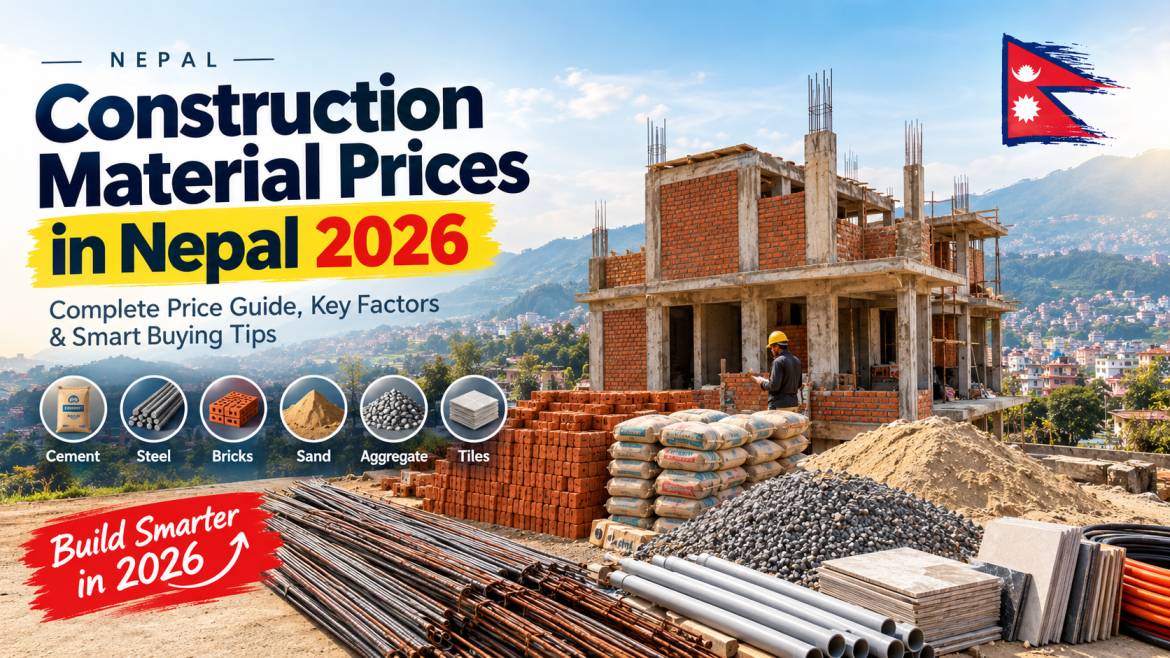
Construction Materials & Costs in Nepal 2026
You'll find that you can get three different answers for the price of a bag of cement from three different suppliers in Kathmandu this week. This price variation is the v
Summarize With AI
Get a quick summary from your favorite AI model
Table of Content
- 1. The National Price Index of Construction Materials in Nepal at a Glance
- 2. Major Construction Materials Used in Nepal
- 3. Cement
- 4. Steel and TMT Bars
- 5. Bricks and Blocks
- 6. Sand
- 7. Aggregate
- 8. Concrete
- 9. Plumbing Materials
- 10. Electrical Materials
- 11. Roofing and Waterproofing Materials
- 12. Finishing Materials
- 13. Construction Material Price Factors
- 14. Material Cost by Construction Stage
- 15. What are the costs of construction materials of a house in Nepal?
- 16. Material Quantity Estimation
- 17. A Guide on How to Select Quality Construction Materials
- 18. Learning How to Save Money on Construction Materials Can Easily Be a Daunting Task
- 19. Common Material Buying Mistakes
- 20. How to Compare Supplier Quotations
- 21. Buying Materials in Kathmandu Valley
- 22. Getting This Right for Your Project
You'll find that you can get three different answers for the price of a bag of cement from three different suppliers in Kathmandu this week. This price variation is the very reason why many first time builders in Nepal either end up paying too much at the shop or over/under estimating the budget even before the foundation is laid. This guide will help you understand the true cost of building materials in 2026, which factors can cause the price to increase or decrease, and how to navigate purchasing them without getting ripped off.
The National Price Index of Construction Materials in Nepal at a Glance
|
Material |
Unit |
Indicative 2026 Price Range (NPR) |
Key Price Factors |
|
OPC cement (structural) |
Per 50kg bag |
700 - 1,050 |
Brand, plant location, transport, VAT |
|
PPC cement (plastering/masonry) |
Per 50kg bag |
600 - 850 |
Brand, transport, seasonal demand |
|
TMT steel (Fe 500D) |
Per kg |
88 - 120 |
Brand, diameter, global billet prices, import duty |
|
Class A brick (Kathmandu Valley) |
Per piece |
16 - 22 |
Kiln location, firing quality, transport |
|
Fly ash brick |
Per piece |
12 - 18 |
Availability, eco-brick tax rebate |
|
River sand |
Per cubic meter |
3,750 - 4,500 |
Source distance, road access, season |
|
20mm aggregate |
Per cubic meter |
3,180 - 4,500 |
Quarry distance, crusher output |
|
Vitrified floor tile (600x600mm, laid) |
Per sq ft |
180 - 350 |
Brand, finish, installation complexity |
These are indicative ranges based on current Kathmandu Valley supplier quotes and the Department of Urban Development and Building Construction (DUDBC) district rate benchmarks, not fixed market prices. What you're actually quoted will shift with your location, the brand and grade you choose, the quantity you order, who you buy from, transport distance, and how close to peak building season you're buying. Always confirm current rates with your local stockist before locking in a budget.
Major Construction Materials Used in Nepal
Cement
Nepal has two types of cements which are used for nearly all purposes. OPC (Ordinary Portland Cement) has high early strength and sets rapidly, it is used for structural RCC work such as columns, beams and slabs. PPC (Portland Pozzolanic Cement) is the cheaper and more water-resistant variety that is used for plastering, brickwork and ordinary masonry. Keep bags on a wood pallet, away from moisture and use them within a couple of weeks of buying, as the cement weakens when exposed to ambient humidity. Look for NS (Nepal Standard) certification from Nepal Bureau of Standards and Metrology (NBSM) before purchasing as the mark is more important than brand name mentioned on the bag in a seismic zone.
Steel and TMT Bars
TMT (Thermo-Mechanically Treated) bars are the reinforcement inside every RCC column, beam, and slab. For earthquake-resistant construction under NBC 105:2020, Nepal's structural code requires the ductile Fe 500D grade throughout the frame, not the cheaper standard Fe 500. On a typical 2,000 sq ft house, expect roughly 7 to 9 metric tonnes of TMT steel, consuming a meaningful share of the total budget. Check for a rolled-in brand mark and grade stamp on the bar itself, and never let a supplier substitute a lower grade to shave a few rupees off the quote; that's the one place where cost-cutting adds real seismic risk. If your home also needs structural strengthening rather than a fresh build, this is the same steel grade used in earthquake retrofitting work.
Bricks and Blocks
Class A bricks made in the Kathmandu Valley are on the higher end of the price spectrum compared to bricks made in the Terai, but are better suited to the valley's clay soil and monsoons. The Fly ash bricks are 15–20 per cent less expensive than clay bricks of the same strength, and are suitable for non-load-bearing walls. Although the individual price of a hollow concrete block may seem more expensive, the total cost per unit area of the wall may be less when it's considered as a large wall run because it occupies more wall area per piece, is laid faster, and offers greater insulating value. In either case, avoid using a piece if it is chipped, under-fired or has cracks in it before it is installed on a wall, and not after.
Sand
Pit sand is not used for any structural concrete, plaster work or for any other purpose except back filling it is the common fine aggregate for plaster and concrete. In areas where river sand is scarce, crushed stone sand (also known as washing sand or M-sand) is now being used. Moisture is a factor in determining the amount of cement a mix requires and so is silt contamination – and a supplier that sells "wet" sand by volume is selling you less usable sand. The most important swing factor here is transport: sand from districts near Kathmandu or Dhading or Melamchi corridor is cheaper than that brought in from more distant districts.
Aggregate
Aggregate (crushed stone chips, 20mm is the normal size used in normal RCC work) is graded by size, and if the wrong grade is used for the element of the structure, this weakens the mix. You are paying for clean, well graded stone with as little dust as possible and even less clay contamination, and a visual inspection of a sample load before it leaves the quarry will tell you a lot. Like sand, the distance from the quarry to your site is likely the most important factor in quarry prices per cubic metre.
Concrete
Volume mixed (site) concrete is still predominantly used in the construction of houses in Nepal. In Kathmandu Valley, ready-mix concrete is becoming more readily available for larger pours, and provides increased uniformity of strength, but the price is higher, and availability requires the use of a mixer truck that narrower-lane plots may not fit. The bottom line is that consistency is worth more than speed – a hurried rushed mix that isn't proportioned correctly is going to be much more expensive to correct later on, and the majority of your construction dollar spent are in the RCC construction area from footing to slab.
Plumbing Materials
The house plumbing in Nepal is a combination of different types of pipes such as uPVC pipes for cold water supply lines and toilets, CPVC pipes for hot water supply lines from solar heaters or geysers (CPVC melts above approximately 70°C), HDPE for borehole and larger pipes, and PPR for some fittings. The indicative ranges for the various materials are NPR 150-2500 per piece for uPVC, NPR 550-2750 per 3 m for CPVC and NPR 100-12000 per roll for HDPE with a heavy dependence on the diameter and pressure ratings of the pipes. Look for the NS 206 mark (embossed on the pipe body not just said by the seller) which is the Nepal standard for PVC pipe. Fittings, valves, and tanks add meaningfully to the total and are usually quoted separately from the structural budget; our plumbing services category covers installation and repair across these systems.
Electrical Materials
Wiring, switches, sockets, conduits, distribution boards, and protection devices (MCBs and earthing systems) form the electrical package. Copper wire gauge should match the circuit load; undersized wire on a high-draw circuit is a fire risk, not just an inefficiency. Distribution boards and MCBs protect the whole system from overload, and skipping proper earthing to save cost is one of the more common corners cut on a tight budget, with consequences that only show up later. For a new build or a rewire, our electrical services category covers house wiring, panel upgrades, and related work.
Roofing and Waterproofing Materials
Nepal's monsoon makes waterproofing a non-negotiable line item, not an optional upgrade. RCC roof slabs need a proper waterproofing membrane or coating system before any tiling or terrace use, and bathrooms and terraces are the two areas where waterproofing failures show up most often as damp patches or ceiling stains on the floor below. Corrugated galvanized iron (CGI) sheets, common on lighter structures and additions, are sold by gauge and bundle; check the NS mark for CGI roofing rather than relying on the seller's stated gauge, since underweight sheets are a known market issue. If you're dealing with an existing leak or planning ahead of monsoon, bathroom waterproofing and related roofing work are worth budgeting for early rather than after the first stain appears.
Finishing Materials
This is the widest category: tiles, tile adhesive and grout, paint, wall putty, false ceiling material, doors, windows, and sanitary fixtures. Standard 600x600mm vitrified tiles offer the best cost-to-durability balance for most homes, while marble and granite sit in the premium bracket. Interior wall painting (primer plus two coats) typically runs NPR 45 to 90 per sq ft of wall area including labour, with exterior weathercoat finishes at the higher end due to added weather resistance. Doors and windows, whether uPVC, aluminum, or seasoned wood, run roughly NPR 650 to 1,800 per sq ft of opening depending on material and whether the frame is factory-fabricated or site-built. Our tile work service covers floor and wall tiling if you'd rather not manage the installation yourself.
Construction Material Price Factors
Material prices in Nepal move for reasons mostly outside any single buyer's control: brand and grade explain part of the spread (Fe 500D from an established mill versus an unbranded supplier, for instance), while quantity, supplier relationships, and location account for just as much. Transport and fuel costs matter enormously in a country where aggregate, sand, and even cement often travel over hill roads to reach a site, and demand firms up in the dry building season from October through April, easing during the monsoon lull. Nepal also imports a meaningful share of its steel billet and finishing materials, so global commodity prices and exchange rates filter through with a lag. The Kathmandu Post reported in mid-2026 that building a standard Kathmandu house had grown roughly 14 percent more expensive over the previous year, with government data pointing to higher fuel and transport costs after renewed conflict in West Asia, though brick producers disputed how much of the cited increase in brick prices was real. The lesson isn't a number to memorize, it's that a quote from three months ago may already be stale.
Material Cost by Construction Stage
-
Foundation: Cement, aggregate, and a smaller share of steel go into excavation, PCC (plain cement concrete), and footings. This stage is usually 8 to 12 percent of total project cost.
-
Structural Frame: Columns, beams, and slabs consume the bulk of your cement and steel, and this single stage typically accounts for 28 to 34 percent of the total budget, more than any other. Getting the new house construction process right at this stage matters more for your final bill than almost any finishing choice made later.
-
Wall Construction: Bricks or blocks, sand, and PPC cement for mortar and initial plastering dominate here, generally 10 to 14 percent of total cost.
-
Roofing: Waterproofing materials, membrane or coating systems, and CGI sheets for lighter roofs or additions.
-
Plumbing and Electrical: Pipes, fittings, wiring, and fixtures together usually run 8 to 11 percent of the total budget, often priced per room or as a lump-sum package for the whole house.
-
Flooring and Finishing: Tiles, tile adhesive, paint, doors, windows, and sanitary fixtures, typically 8 to 12 percent for flooring and joinery combined, with painting and finishing adding another 6 to 9 percent.
Spending accumulates unevenly across a project. The structural frame alone can equal everything else combined, which is why cutting corners on cement or steel grade to "save money early" almost never pays off once you account for the finishing stages still to come.
What are the costs of construction materials of a house in Nepal?
There isn't any definitive answer, and anybody stating one flat number without finding out about your project is leaving steps. The material cost is dependent on the built-up area, number of floors, structural design and soil requirements, the specification grade selected for each material, the finishing level, location, transport distance, and the way the architectural and MEP (mechanical, electrical, plumbing) design is planned. In general, materials account for 55 to 65 percent of the total cost of construction in Nepal, while labour, permits and design fees comprise the bulk of the remaining costs. The only way to convert that percentage to a specific number for your plot is with a proper Bill of Quantities, which is created based on your drawings and not a generic per-square-foot multiplier.
Material Quantity Estimation
Homeowners can reasonably estimate a few things themselves: estimate the approximate area of the rough tile around a room based on room dimensions, the area of the paint on the walls based on the surface area of the wall in the room, and a general idea of the number of doors and windows based on the floor plan. Structural quantities on the other hand are something different. Cement bags, tonnage of steel, and concrete volumes for footings, columns, beams and slabs should be based on your structural engineer's calculations and an accurate BOQ (bill of quantities) which shouldn't be based on a generic online formula or a rule of thumb derived from a neighbour's project. The quantity of steel required for a particular house can vary significantly depending on the soil bearing capacity, number of floors and seismic design requirements, for houses that have the same floor area. It should be the order of the structural drawing, quantity takeoff, and then the purchase order.
A Guide on How to Select Quality Construction Materials
-
Before purchasing cement, inspect the NS, purchase from a stockist who has a quick turnover of stock (cement bags should not be stored, as they will absorb moisture from the air), and be sure the manufacture date is current.
-
When purchasing steel: inspect the bar for the rolled brand and grade stamp, uniform ribbing, and rust pitting, and purchase from an authorized dealer, not from an unmarked stockpile.
-
Before buying bricks: Conduct a break test on a sample – a good fired brick should break without crumbling, and produce a clear metallic sound.
-
To ensure the sand you're buying is not contaminated, thoroughly check it for excessive silt (water will reveal the amount of silt that settles out) and make sure it is not visibly wet or organic debris.
-
Before purchase: Check if the stone is free of dust and clay lumps and if the size is in line with the specified gradation.
-
When buying plumbing materials: Always the NS 206 mark should be embossed on the pipe; Always match pipe type to application (Never use regular PVC for hot water lines); Do not skimp on fittings, a good pipe with a poor fitting is still a leaky pipe.
-
Before buying Electrical Materials: Ensure the required wire size is appropriate to the circuit load, purchase electrical switches and MCB from a recognized manufacturer and do not skimp on earthing items.
-
Before purchasing Tiles and Finishing Materials: Ensure that the batch/shade numbers are the same in each box (the tiles may look different from batch to batch), edges are chipped free and quantity has been specified with a wastage allowance for cuts.
Learning How to Save Money on Construction Materials Can Easily Be a Daunting Task
-
Obtain quotes from several suppliers and compare the actual delivered cost, NOT the unit price.
-
Purchase goods as needed, not as much at once as you can.
-
Minimize losses by estimating quantity, handling, etc.
-
Please verify exact specifications (grade, brand, size) prior to ordering.
-
Maintain a materials schedule and ensure the materials are bought when needed for each stage of construction.
-
Monitor deliveries to order to identify any delays at the earliest opportunity.
-
Keep all of your bills (for warranty and rate comparison).
-
Coordinate the purchase with your contractor or engineer instead of purchasing on your own.
None of this means chasing the cheapest structural materials. Save on tile brand or paint quality; never on cement or steel grade, since that risk lands in the structure itself, not the invoice.
Common Material Buying Mistakes
-
Choosing a supplier based only on the lowest quoted unit price
-
Ordering without checking the exact specification against what the site needs
-
Ordering excessive quantities that then sit exposed to weather
-
Poor on-site storage that lets cement absorb moisture or steel start rusting
-
Ignoring transportation charges until they show up as a surprise on the final bill
-
Not physically checking delivered quantities against the invoice
-
Changing brand or specification mid-project without running it past the engineer
-
Buying finishing materials too early, before the site is actually ready for them
How to Compare Supplier Quotations
|
Item |
Supplier A |
Supplier B |
Supplier C |
What to Check |
|
Unit price |
NPR 950/bag |
NPR 880/bag |
NPR 1,020/bag |
Price per bag/kg/piece, not just a lump sum |
|
Quantity |
500 bags |
500 bags |
500 bags |
Matches your BOQ exactly, no rounding up |
|
Brand/specification |
OPC, NS marked, mfg. this month |
OPC, NS marked, mfg. 2 months ago |
OPC, NS marked, mfg. this month |
Grade, NS mark, manufacture date |
|
Delivery |
Included |
NPR 15,000 extra |
Included |
Included or charged separately, and how far |
|
Taxes/charges |
VAT included |
VAT + 2% municipal charge extra |
VAT included |
VAT and any municipal charges included or extra |
|
Warranty/return terms |
Replaces damaged bags on delivery |
No return policy stated |
Replaces damaged bags within 3 days |
What happens if delivered quality doesn't match |
|
Total delivered cost |
NPR 475,000 |
NPR 462,900 |
NPR 510,000 |
The only number that's actually comparable |
The lowest unit price on a quotation rarely means the lowest overall cost. A supplier quoting a cheaper cement rate but charging separately for delivery, or padding the invoiced quantity, can end up costing more than a slightly higher quote that's all-inclusive. Always ask each supplier to quote the same specification and quantity so you're comparing the same thing three times over, not three different things.
Buying Materials in Kathmandu Valley
Kathmandu, Lalitpur, and Bhaktapur bring their own constraints. Narrow lanes and limited site access often mean large deliveries get broken into smaller loads, which adds cost, and storage space on a typical urban plot is tight enough that timing purchases to your schedule matters more here than where there's room to stockpile. Traffic restrictions on heavy vehicles in parts of the valley can also affect when deliveries arrive, so confirm this with your supplier before counting on one for a specific work day. Comparing two or three suppliers within the valley is usually worth it, since transport distance from the same quarry or plant can vary block to block depending on where a supplier's yard sits.
Getting This Right for Your Project
The habits that make a smooth build a stressful one are close scrutiny of materials, checking current price, checking quality at delivery, planning quantities against actual drawings, and comparing delivered cost (total) not stickers: they are all carefully reviewed. Even with a generic guide, like this one, a well prepared BOQ and a professional structural review was better than any generic guide for your particular plot, soil and design. For any build project in Kathmandu, Lalitpur and Bhaktapur, free consultation and site-specific estimate from ConstructionSewa or make a conversation with the verified engineer / contractor to convert these ranges into quotation for the build.
Frequently asked questions
Community
Likes and comments
Like the post if it helped you, and leave a comment to share your experience. Every comment is reviewed by our admin team before it appears publicly.
Want to join the conversation?
Sign in to leave a comment. Every comment is reviewed by our admin team before it becomes public.
Log in to commentApproved comments
Showing the latest approved conversation for this post.
No approved comments yet
Be the first to start a conversation once your comment is approved.