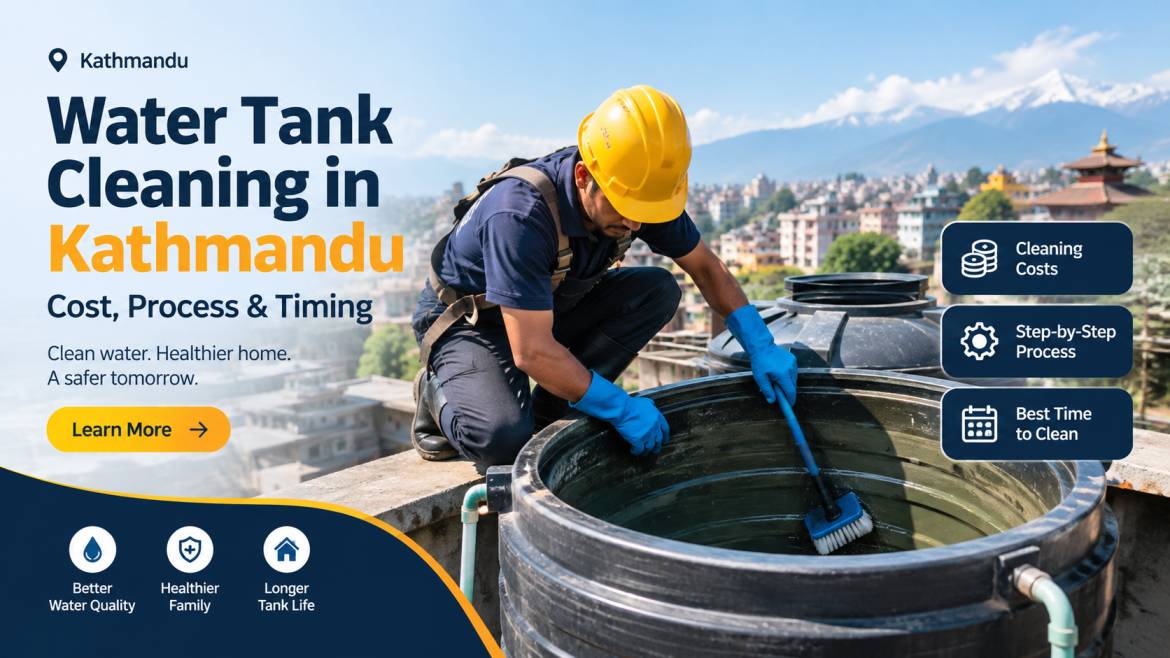
Water Tank Cleaning in Kathmandu: Cost, Process & Timing
If water in the tap appears clear and clean at the meter, and tastes musty when it gets to the kitchen, it is rarely a Kathmandu problem. That's what you've been using in
Summarize With AI
Get a quick summary from your favorite AI model
Table of Content
- 1. Why Tanks in the Valley Dirt Easier than You Expect?
- 2. Signs Your Tank Actually Needs Cleaning
- 3. Why and how the next few weeks matter.
- 4. Overhead Tanks and Underground Reserve Tanks Need Different Care
- 5. What Nepal's Drinking Water Standard Actually Measures
- 6. What a Professional Cleaning Actually Involves
- 7. What It Costs in Kathmandu Valley
- 8. DIY Cleaning vs Hiring a Professional
- 9. Worth Checking at the Same Time
If water in the tap appears clear and clean at the meter, and tastes musty when it gets to the kitchen, it is rarely a Kathmandu problem. That's what you've been using in your tank!
This is much more important in the Kathmandu Valley than almost anywhere else, as very few households in this valley receive water directly from a pipe on demand. Most houses keep it before them, in some instances for days, and a tank that is not cleaned quietly and regularly undoes the quality of the water when it arrives.
Why Tanks in the Valley Dirt Easier than You Expect?
The piped network is operated by Kathmandu Upatyaka Khanepani Limited (KUKL) in the Valley, but the piped network is not sufficient to meet the demand. Many households fill in the void with tanker water, private groundwater extraction or 20 litre jars, and researchers measuring the Valley's water supply have discovered that this alternative source water is frequently loaded with bacteria from total coliform bacteria levels that exceed the Nepal drinking water limits. Every one of those sources gets stored the same way once it reaches your rooftop or courtyard: in a tank.
That storage step is where things go wrong. A plastic overhead tank exposed to direct sun grows algae inside surprisingly fast, even when the lid looks intact. A cemented or RCC reserve tank fed by tanker deliveries collects fine silt at the bottom load after load, since tanker water is rarely as clean as piped supply to begin with. Add Kathmandu's iron and manganese-rich groundwater, and you get the reddish sludge that eventually shows up as rust-coloured water at the tap, long after the tank itself is the actual source of the problem.
Signs Your Tank Actually Needs Cleaning
A few warning signs are worth acting on rather than waiting out:
-
Water that looks cloudy, yellowish, or has a faint green tint, especially right after the tank refills
-
A musty or earthy smell that wasn't there a few months ago
-
Visible grit or a slimy film when you look inside the tank or check an outlet screen
-
Falling water pressure at taps, which is often sediment clogging aerators and valves rather than a supply problem (this is a common trigger for a tap and valve replacement call that turns out to be a tank issue instead)
-
A water pump or motor that seems to be working harder than usual, since silt pulled into the line can strain a water motor over time
-
Repeated stomach upsets in the household with no other obvious cause
Considering it's not contamination on its own, but two or more of the following are good reasons to have the tank inspected rather than assumed to be from the municipal water supply.
Why and how the next few weeks matter.
The general recommendation from cleaning companies in Kathmandu Valley is to clean residential tanks every six months and commercial or high turnover tanks like offices, hotels or hostels, every three months. It is generally a time when the two cleanings coincide with the monsoon season.
The Department of Hydrology and Meteorology has determined that the onset of the normal monsoon season in the country is on 13th June and the withdrawal is on 2nd October, which means that a pre-monsoon cleaning of a tank in late May or early June would be beneficial, before the peak of the rainy season and the most significant influx of high amounts of turbidity/silt, and a second cleaning when rainfall slows down in September or October will remove the silt that has been washed in during the rainy season. This year's monsoon was slightly later, about a week, but the retreat period is around the same window of the autumn season.
There's a second reason this particular window matters locally. Dashain falls from 11 to 25 October in 2026, and cleaning the house thoroughly before the festival, tank included, is a routine part of getting ready for it in most Kathmandu Valley households. Booking a tank cleaning now, while the monsoon is winding down and before the pre-Dashain rush fills up contractors' schedules, tends to be far less stressful than trying to arrange it the week before Tika.
Overhead Tanks and Underground Reserve Tanks Need Different Care
Most homes in the Valley end up with more than one storage tank, and they don't get dirty in the same way or need the same handling.
Overhead tanks, whether plastic, fibreglass, or steel, sit on the roof and are easy to reach but exposed to sunlight, which is exactly what algae needs to establish itself along the inner walls. Cleaning them is quicker but still requires draining, scrubbing the walls and lid gasket, and a proper rinse before disinfection.
Underground or ground-level reserve tanks, usually built in cement or RCC, hold a larger volume and take in most of the sediment from tanker deliveries, since that's usually where tanker water is pumped in first. Because someone typically has to enter the tank to remove sludge properly, this work should only be done by a team trained in confined space entry, with checks for breathable air before anyone goes in. This is one of the more overlooked safety gaps when tank cleaning is left to informal or unverified help.
What Nepal's Drinking Water Standard Actually Measures
Nepal's current National Drinking Water Quality Standard, 2079, issued by the Ministry of Water Supply, sets a maximum turbidity of 5 NTU, requires E. coli to be completely absent, and allows total coliform in no more than 5 percent of samples. It also caps iron at 0.3 mg/L, which lines up with the rust-tinted water many Valley households already recognise from groundwater sources.
The standard governs what a water supplier delivers up to the point of connection. It says nothing about what happens after that water sits in your tank for a few days, which is precisely the gap a dirty tank exploits. Water that met every one of those limits when it left the source can still fail them by the time it reaches your glass, simply because of what it picked up in storage.
What a Professional Cleaning Actually Involves
A proper job goes well beyond hosing out the visible dirt. It typically starts with draining the tank fully, followed by manual removal of the sludge and sediment layer that pumps alone can't lift out, a scrub of the walls, floor, and lid with tools that won't scratch the tank's inner surface, and a food-grade disinfectant rinse before the tank is refilled and tested.
ConstructionSewa's overhead water tank cleaning service follows a straightforward booking flow: you request a site visit, a contractor inspects the tank and shares a written estimate before any work starts, the job is scheduled with milestone-based payments, and it closes out with a quality check and warranty terms on handover. That inspection step matters more than it sounds. Tank size, material, access, and how much sediment has built up all affect the actual scope of work, and a same-day visual estimate over the phone is rarely accurate.
What It Costs in Kathmandu Valley
Pricing across the Valley's cleaning providers generally follows tank size and material rather than a flat call-out fee. As a rough guide from publicly listed rate cards:
-
Overhead plastic or steel tanks in the 500 to 3,000 litre range typically run somewhere between NPR 1,000 and 4,500
-
Underground or reserve concrete tanks cost more given their size and the sludge they accumulate, often landing between NPR 2,500 and 9,000 for tanks up to roughly 20,000 litres
-
Very large or combined tanks (overhead plus underground in one visit) are usually billed per litre beyond a base threshold, commonly in the range of 30 to 70 paisa per litre depending on tank type
-
A transport surcharge of around NPR 100 to 200 is common for addresses outside the Ring Road
These are indicative ranges rather than a quote. Actual pricing depends on how much sediment has built up, how accessible the tank is, and whether it needs disinfection alone or a full scrub. Booking a site visit gets you a number based on your actual tank rather than an average.
DIY Cleaning vs Hiring a Professional
Emptying a small rooftop tank and rinsing it yourself isn't unreasonable. Entering an underground reserve tank without training is a different matter, since these are confined spaces where air quality can't be assumed safe, and a fall or slip inside a partially drained tank is a real risk. Household bleach or soap also tends to leave residue or fails to fully break down the biofilm layer that forms on tank walls, which is exactly the layer that shelters bacteria between cleanings. For a small, accessible overhead tank, a careful DIY rinse between professional visits can help. For anything requiring tank entry, it's not worth the risk.
Worth Checking at the Same Time
A tank cleaning is a good moment to look at the rest of your storage and supply setup, since the same sediment that dirties your tank often affects connected fittings too. If the tank itself is old, cracked, or was never sized correctly for the household, it may be due for a water tank installation rather than another round of cleaning. Ageing GI pipes feeding the tank are a common source of the rust particles that make cleaning necessary in the first place, which a water supply line inspection can confirm.
If your tank hasn't been checked since before this year's monsoon, booking it now rather than in the middle of Dashain preparations is the easier path. You can request a free site visit and get a written estimate before any work begins.
Meta Description: When and how often to clean a water tank in Kathmandu, what it typically costs, and why the weeks before Dashain are the smartest time to book one.
Frequently asked questions
Community
Likes and comments
Like the post if it helped you, and leave a comment to share your experience. Every comment is reviewed by our admin team before it appears publicly.
Want to join the conversation?
Sign in to leave a comment. Every comment is reviewed by our admin team before it becomes public.
Log in to commentApproved comments
Showing the latest approved conversation for this post.
No approved comments yet
Be the first to start a conversation once your comment is approved.