
Minor Structural Repair Services in Nepal
Not every crack that shows up on a wall means the house is in trouble, and not every crack is safe to ignore either. Here's the thing: most homeowners we meet fall into o
Summarize With AI
Get a quick summary from your favorite AI model
Table of Content
- 1. What Counts as a Minor Structural Repair
- 2. Hairline Cracks vs Structural Cracks: How to Tell the Difference
- 3. The most common causes of the cracks in Nepali buildings are as follows:
- 4. · Hairsline cracking can be caused by a moderate tremor, particularly around openings at doors and windows.
- 5. · shrinkage of concrete and masonry due to temperature changes in the Kathmandu area, especially on walls exposed to direct sunlight
- 6. · Inadequate curing time, inadequate mixing of mortar, and inadequate reinforcement during construction
- 7. Our Minor Structural Repair Process
- 8. Repair Techniques We Use
- 9. Cracks Linked to Water, Plumbing and Roofing Issues
- 10. What Affects the Cost of Minor Structural Repairs
- 11. Talk to Us Before the Crack Gets Worse
Not every crack that shows up on a wall means the house is in trouble, and not every crack is safe to ignore either. Here's the thing: most homeowners we meet fall into one of two camps. Some panic the moment they spot a hairline crack near a door frame. Others watch a crack widen for a year or two and only call once water starts coming through it. Minor structural repairs sit right in the middle of those two reactions, and figuring out which camp your crack belongs in is honestly most of the job.
At constructionsewa, we send verified technicians and engineers to inspect, diagnose and fix minor structural repairs, wall cracks, plaster damage and localised structural issues, for homeowners across Kathmandu, Lalitpur, Bhaktapur and other districts. In most projects we've handled, the fix itself is straightforward once the cause is properly identified. This page walks through how we assess a crack, what usually causes structural repairs of buildings in Nepal, and when a minor repair is genuinely enough.
What Counts as a Minor Structural Repair
Minor structural repairs cover the kind of damage that affects a building's finish and, sometimes, its immediate stability, without pointing to a foundation or load bearing failure. That includes wall cracks, corner cracks near openings, plaster cracking, small settlement cracks, and patchwork after a leak or a wall opening has been closed up. It's different from major structural repair, which involves beams, columns, footings or a full structural rebuild and needs a structural engineer leading the job rather than a site technician.
Where people get confused is assuming every crack falls into one category or the other. From our experience, most cracks start as minor issues and only escalate into something serious when the underlying cause, usually moisture or ongoing settlement, is never actually addressed.
Hairline Cracks vs Structural Cracks: How to Tell the Difference
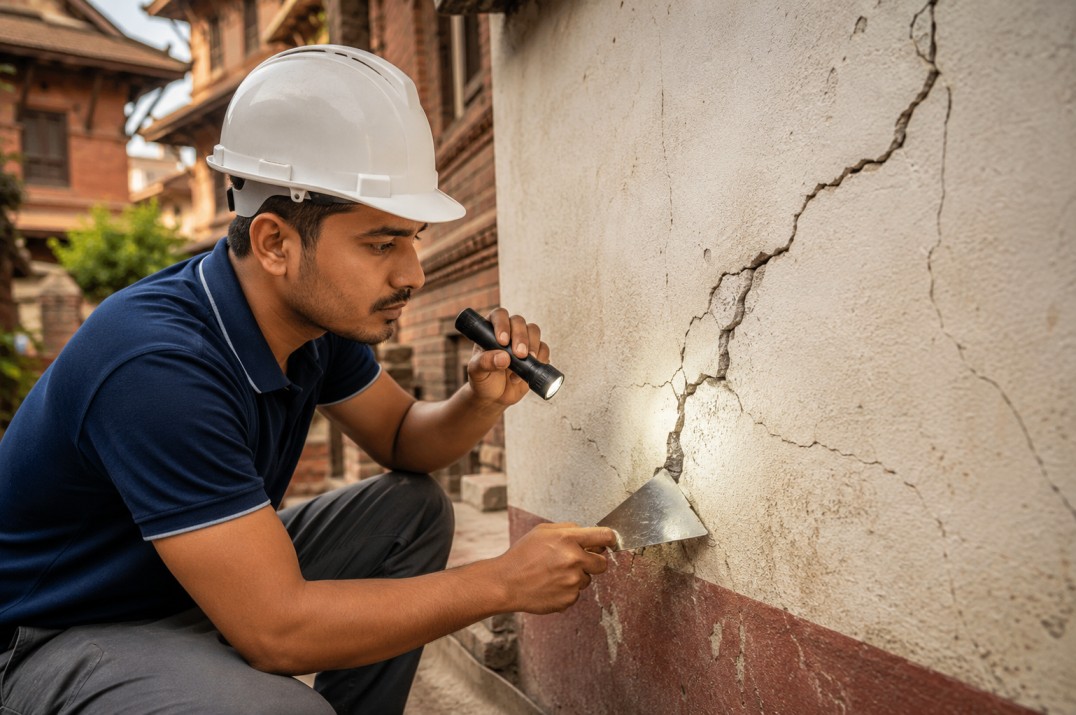
Hairline cracks are thin, shallow and usually show up near door and window corners or wherever plaster meets a different material. These are typically cosmetic, caused by minor settlement, or by the temperature and humidity swings that Kathmandu Valley buildings go through every year. Structural cracks are wider, often follow a diagonal or stepped pattern through the brickwork, and can point to a genuine issue with the foundation or a load bearing wall.
A widely referenced international standard, BRE Digest 251, classifies crack severity by width and pattern, running from negligible hairline cracking that needs nothing more than routine decoration, up through categories that call for monitoring, and finally to cracks serious enough to require structural intervention. We use this kind of framework as a general guide during inspection, not a strict rulebook, because a building's history and construction quality matter just as much as the width of the crack itself.
There's one thing in Nepal that pops up more than in virtually any other area: seismic movement. Cracking that appears alarming, but is stable, or that appears minor but is an indication of movement within the wall, can occur in a building that has experienced moderate shaking. This is why it's important to have a proper site inspection rather than attempting to diagnose a crack from a photo.
The most common causes of the cracks in Nepali buildings are as follows:
· Hairsline cracking can be caused by a moderate tremor, particularly around openings at doors and windows.
· The settlement of the foundation may occur unevenly and can be a problem on sloped lots or on fill that has not been compacted properly; it creates diagonal cracks in masonry.
· Over time, plaster and masonry soften from moisture and water infiltration as seen in a leaking pipe, poorly waterproofed terrace, or rising damp.
· shrinkage of concrete and masonry due to temperature changes in the Kathmandu area, especially on walls exposed to direct sunlight
· Inadequate curing time, inadequate mixing of mortar, and inadequate reinforcement during construction
· Cracking that occurs as a result of the age and general wear of older buildings is naturally occurring and some may be cosmetic, while others may warrant a closer inspection.
Our Minor Structural Repair Process
Honestly, the process matters more than the product you fill a crack with. Here's roughly how a job goes from the first call to a finished wall:
● Site inspection: a technician examines the crack pattern, width, location and any related signs, like damp patches or doors and windows that no longer close properly
● Diagnosis: working out whether the cause is cosmetic settlement, ongoing moisture, or something serious enough to need a structural engineer's opinion before we touch anything
● Preparation: cleaning out the crack, removing loose or crumbling material, and dealing with any moisture source first, because filling a wet crack rarely holds
● Repair: filling hairline and fine cracks with an appropriate mortar or filler, or crack stitching with reinforcement for wider cracks that need more than surface patching
● Finishing: replastering and repainting the repaired section so it blends into the surrounding wall rather than standing out as an obvious patch
● Follow up: for borderline cracks, we recommend a short monitoring period to confirm the repair has actually held before calling the job closed
Repair Techniques We Use
Not every crack gets the same treatment, and that's kind of the point of a proper diagnosis first. For fine, stable cracks, a flexible filler or polymer modified mortar usually does the job. For cracks that run deeper into the wall, epoxy or polyurethane injection seals the gap and restores some bonding strength between the two sides. Wider or actively moving cracks often call for crack stitching, where stainless steel or helical bars are set into the mortar joints across the crack to tie the masonry back together mechanically rather than relying on filler alone.
Where a crack has damaged the surrounding finish, our texture and decorative paint service can match and refinish the repaired section so it doesn't stick out against the rest of the wall.
When a Crack Needs More Than a Minor Repair
Most cracks we get called out for are genuinely minor, but some are early warning signs of a bigger structural conversation. It's worth calling in a proper assessment, not a quick patch job, if:
● The crack is wider than a few millimetres and keeps widening over weeks or months
● It runs diagonally through multiple courses of brickwork rather than staying confined to the plaster
● Doors or windows nearby have started sticking or no longer close properly
● The crack shows up alongside a visible tilt or bulge in the wall
● It reappears soon after a previous patch job, which usually means the real cause was never fixed
Cracks Linked to Water, Plumbing and Roofing Issues
A good number of the cracks we get called out for aren't purely structural at all. They're moisture problems wearing a structural crack's clothing. A poorly waterproofed terrace lets water track down through a slab edge. A slow leak behind a wall softens the plaster from the inside out long before anyone notices a stain.
If the source turns out to be roof related, our RCC roof waterproofing service addresses that directly. Where an ageing or damaged water supply line is the culprit, or a worn tap or valve is dripping into a wall cavity, fixing that stops the crack from simply reopening a few months later. And where a blocked or damaged sewage and drainage line is pushing water against a foundation wall, resolving that source matters more than repainting the symptom.
What Affects the Cost of Minor Structural Repairs
We don't quote a flat rate over the phone, and honestly, any contractor who does without seeing the crack first is guessing. Cost depends on a handful of things: how many cracks need attention, whether the repair is surface filling or full crack stitching, how much plaster and paint work is needed to finish the wall, and whether scaffolding or access equipment is required for upper floors. A single hairline crack near a window is a small job. A stitched crack across a load bearing wall with full replastering is a bigger one. That's exactly why we start every project with a free site visit and give you a written estimate before any work begins, rather than a number pulled out of thin air.
If the repair also involves closing up or reshaping an opening, our wall opening service handles that as part of the same project.
Talk to Us Before the Crack Gets Worse
If you've been putting off calling someone because you're not sure whether it's serious, that hesitation is completely understandable. Most people can't tell a cosmetic crack from a structural one just by looking at it, and that's fine, it's not something you're expected to know. Book a free site visit with constructionsewa and a technician will inspect the crack, give you an honest read on what's causing it, and hand over a written quotation before any work begins.
From there, you can pick an inspection date, ask as many questions as you need to, and move forward only when you're ready. Get your free quotation, speak with an expert about what your specific wall needs, and fix the problem properly instead of patching over it again.
Frequently asked questions
Community
Likes and comments
Like the post if it helped you, and leave a comment to share your experience. Every comment is reviewed by our admin team before it appears publicly.
Want to join the conversation?
Sign in to leave a comment. Every comment is reviewed by our admin team before it becomes public.
Log in to commentApproved comments
Showing the latest approved conversation for this post.
No approved comments yet
Be the first to start a conversation once your comment is approved.