Home Construction Loan Process in Nepal: Full Guide
Planning to build your dream home? This complete guide explains the house construction loan process in Nepal, from eligibility and required documents to property valuation, loan approval, and stage-wise disbursement. Learn how banks evaluate applications, avoid common mistakes, and prepare everything you need for a faster, hassle-free construction loan approval
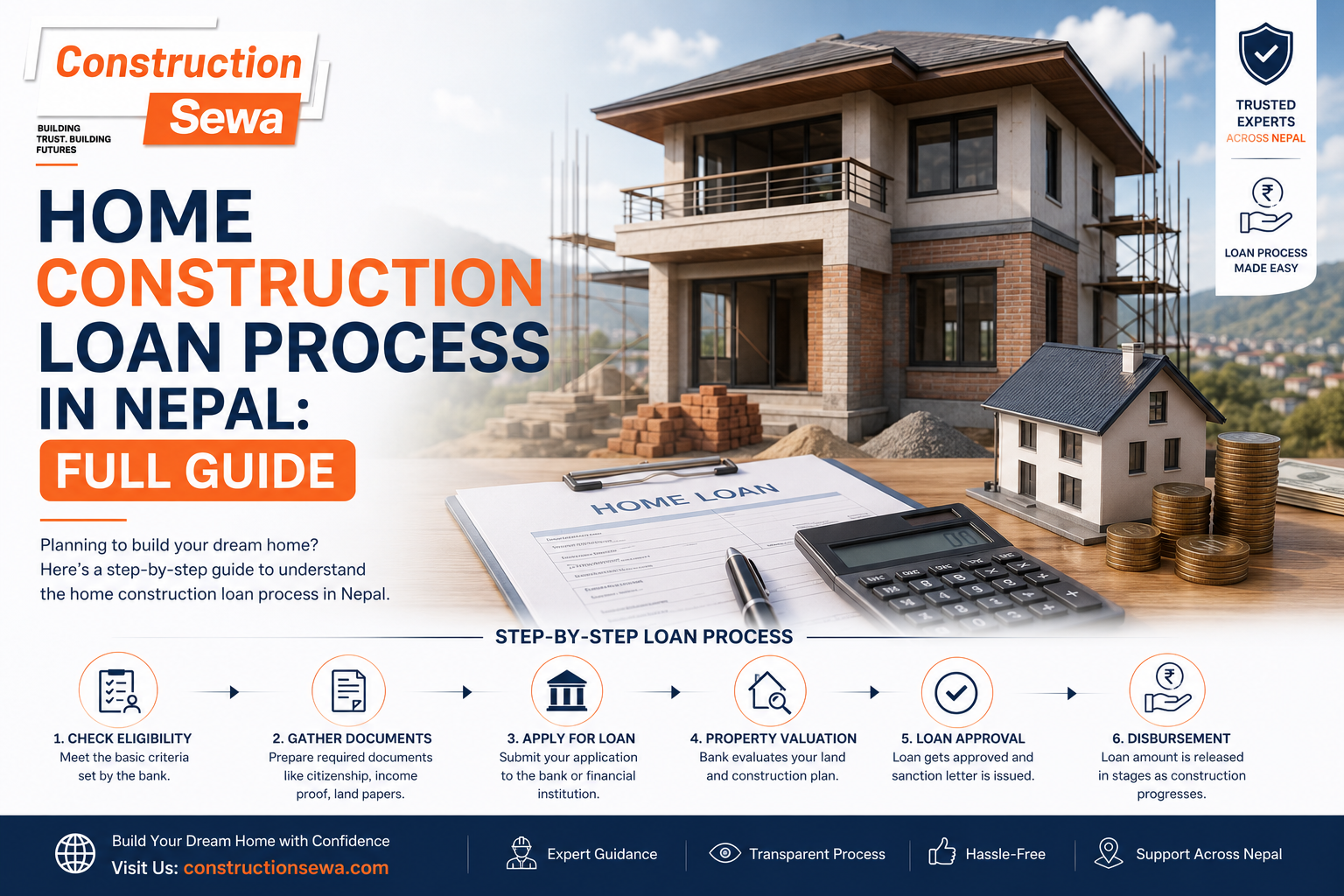
Table of Content
- 1. What Is a Home Construction Loan?
- 2. How the Home Construction Loan Process Works in Nepal
- 3. Determine Your Budget
- 4. Choose Your Construction Company
- 5. Prepare House Design & Cost Estimate
- 6. Gather Required Documents
- 7. Submit Your Loan Application
- 8. Property Valuation
- 9. Loan Approval
- 10. Loan Agreement
- 11. Construction Begins
- 12. Stage-wise Loan Disbursement
- 13. Final Inspection
- 14. Required Documents
- 15. Loan Eligibility
- 16. Construction Loan vs Home Purchase Loan
- 17. Factors That Affect Loan Approval
- 18. Common Mistakes to Avoid
- 19. Why Choosing the Right Construction Company Matters
- 20. Frequently Asked Questions
- 21. Conclusion
If you've started researching the home construction loan process in Nepal, you've probably noticed how scattered the information is one bank's website says one thing, a relative tells you something else, and none of it adds up. Honestly, that's the biggest reason people get stuck before they even submit an application. Because a construction loan works differently from a straightforward home purchase loan, the home construction loan process in Nepal comes with its own paperwork, approval stages, and set of questions lenders will ask you. I've spent time going through this process with families building their first home, and the confusion is almost always the same not whether they qualify, but what order things actually happen in. This guide walks through each stage in plain language, so you know what to prepare before you walk into a bank branch.
What Is a Home Construction Loan?
Before you can follow the home construction loan process in Nepal, it helps to understand what actually makes this loan type different. A home construction loan is financing specifically meant for building a house on land you already own, rather than buying a finished property. So while a regular home loan disburses the full amount at once against a completed house, a construction loan releases funds in stages as the building progresses.
Here's the thing: lenders can't just hand over the full loan amount upfront for a house that doesn't exist yet. They need proof that the money is actually going toward construction, which is why the documentation for a construction loan tends to be heavier than for a purchase loan.
Who can apply? Generally, anyone who owns land (or has clear legal rights to it), has a steady income source, and meets a bank's internal eligibility criteria can apply. Requirements do vary between lenders, so it's worth checking directly with the bank you're considering.
Why the extra documentation? Because the bank is essentially betting on a project that hasn't been built yet. They want to see your house design, your cost estimate, and your municipality approval before they commit funds, because those documents tell them the project is realistic and legally sound.
When do homeowners typically apply? Most people apply for a house construction loan Nepal-wide once they've already secured the land and have at least a preliminary design in hand applying too early, before you know your actual construction cost, often leads to a mismatch between what you request and what you actually need.
How the Home Construction Loan Process Works in Nepal
Every bank structures its internal review a little differently, but the home construction loan process in Nepal tends to follow a fairly consistent sequence.
Determine Your Budget
Start by working out a realistic number for what your home will actually cost, not just what you'd like to spend this is the first real step in the home construction loan process in Nepal, and getting it wrong here throws off everything that follows. This includes land-related costs you've already covered, construction materials, labor, permits, and a contingency buffer for the unexpected because something unexpected almost always comes up.
Choose Your Construction Company
Picking a contractor before you finalize your loan application matters more than people realize. A credible construction company can help you put together a realistic cost estimate, which is exactly what your bank will ask for later. Working with an experienced residential construction team from the start also means your design and budget are grounded in reality rather than guesswork.
Prepare House Design & Cost Estimate
Your bank will want to see an architectural drawing along with a detailed cost breakdown. This is where architecture design support becomes genuinely useful a design that accounts for your actual budget avoids the awkward situation of falling in love with a plan you can't finance.
Gather Required Documents
This step trips up more applicants than any other part of the home construction loan process in Nepal, mostly because people don't realize how many documents are involved until they're asked for them one at a time. We'll cover the full checklist below so you can prepare everything in one go instead of making repeat trips to the bank.
Submit Your Loan Application
Once your documents are ready, you submit your formal application along with the supporting paperwork the point where the home construction loan process in Nepal officially begins moving through the bank's internal system. Most banks will assign you a relationship officer or loan officer who reviews the file for completeness before it moves further.
Property Valuation
The bank arranges a valuation of your land (and sometimes the projected value of the completed structure) to confirm it supports the loan amount you're requesting. This valuation step is a core part of the home construction loan process in Nepal, since it protects both you and the lender from over-borrowing against an inflated property value.
Loan Approval
After documentation review and valuation, the bank's credit team assesses your eligibility and approves or requests revisions to your application. This is usually the longest wait in the entire home construction loan process in Nepal, and approval timelines differ from bank to bank, so it's best to ask your specific lender for their expected turnaround rather than assuming a fixed number.
Loan Agreement
Once approved, you'll sign a formal agreement outlining the disbursement schedule, interest terms, and repayment conditions for the home construction loan process in Nepal. Read this carefully; it's the document that governs everything that follows.
Construction Begins
With the agreement signed, construction can officially start. Most banks require photographic or physical progress verification before releasing each subsequent tranche of funds.
Stage-wise Loan Disbursement
Rather than releasing the full loan amount at once, the home construction loan process in Nepal disburses funds in stages typically tied to milestones like foundation completion, structural framing, and finishing work. It's a bit like paying a taxi meter instead of handing the driver a lump sum upfront the bank pays for distance actually covered, not distance promised. This protects the lender from releasing money faster than construction progresses, and it protects you too, since it prevents overspending early on.
Final Inspection
Once construction wraps up, the bank conducts a final inspection to confirm the completed structure matches what was financed the last checkpoint in the home construction loan process in Nepal before the loan typically converts to standard repayment terms.
Required Documents
Gathering paperwork piecemeal is one of the slowest parts of the home construction loan process in Nepal. So here's a general checklist though it's worth confirming with your specific bank, since construction loan documents Nepal requirements can vary slightly between lenders.
|
Document |
Purpose |
|
Citizenship Certificate |
Confirms your legal identity as the applicant |
|
Land Ownership Certificate |
Proves you legally own the land you're building on |
|
House Design |
Shows the bank what's actually being constructed |
|
Municipality Approval |
Confirms the design is legally permitted to be built |
|
Cost Estimate |
Establishes the total project cost the loan is based on |
|
Income Proof |
Demonstrates your capacity to repay the loan |
|
Bank Statements |
Shows your financial history and existing obligations |
|
PAN (if required) |
Used for tax and identity verification purposes |
|
Tax Documents |
Confirms your tax compliance status |
|
Passport-size Photos |
Standard requirement for identity records |
Loan Eligibility
Eligibility is one of the first things people worry about in the home construction loan process in Nepal, and banks generally look at a combination of factors, though exact thresholds differ by institution.
• Age Most lenders require applicants within a working-age range, often with the loan term ending before retirement age.
• Income A stable, verifiable income source is typically required, whether from employment, business, or another documented source.
• Employment Salaried applicants usually need employment verification, while self-employed applicants provide business registration and income records instead.
• Credit history A clean repayment history generally improves your standing, while missed payments can work against you.
• Property ownership Since the loan is tied to land you own, clear legal title is a basic requirement.
• Debt-to-income ratio Banks assess how much of your income is already committed to existing debt before deciding how much more you can borrow.
Construction Loan vs Home Purchase Loan
People often assume the home construction loan process in Nepal works the same way as a regular home purchase loan. But how the two are structured is actually quite different, and understanding that difference upfront saves a lot of confusion later.
|
Factor |
Construction Loan |
Home Purchase Loan |
|
Disbursement |
Released in stages as construction progresses |
Released as a lump sum at purchase |
|
Documentation |
Requires design, cost estimate, and municipality approval |
Requires property title and sale agreement |
|
Valuation basis |
Land value plus projected completed structure |
Existing completed property |
|
Risk to lender |
Higher, since the asset doesn't exist yet |
Lower, since the property already exists |
|
Monitoring |
Ongoing progress checks before each disbursement |
Typically none after disbursement |
Factors That Affect Loan Approval
Look, a lot of small details feed into how a bank evaluates the home construction loan process in Nepal for any given applicant. Here are the ones that come up most:
• Your credit score and repayment history on prior loans
• Your monthly income relative to the loan amount requested
• Existing loans or financial obligations you're already carrying
• How realistic and detailed your construction cost estimate is
• Whether your property documents are complete and free of disputes
• Whether your municipality approvals are fully in place before you apply
Common Mistakes to Avoid
I've seen the same handful of mistakes trip up otherwise well-prepared applicants throughout the home construction loan process in Nepal, so it's worth knowing them ahead of time.
Underestimating construction costs. This happens constantly, usually because people price out materials at today's rates without accounting for price fluctuations over a multi-month build. A cost estimate that's too tight leaves no room for the unexpected.
Choosing an inexperienced contractor. An unqualified contractor might quote a cheaper number upfront, but weak estimates and poor planning tend to show up later usually when the bank reviews your disbursement request.
Missing approvals. Skipping or delaying municipality approval is a common shortcut people take to save time, but it can stall your entire loan application since banks won't disburse funds against an unapproved structure.
Incorrect documentation. Small errors a mismatched name spelling, an outdated citizenship copy can delay approval by weeks. Because banks review documents strictly, it's worth double-checking everything before submission.
Ignoring contingency costs. So many first-time builders budget exactly to their estimate with nothing extra set aside. But construction rarely goes exactly to plan, and a contingency buffer of some kind is what keeps a project from stalling mid-build when costs shift.
Why Choosing the Right Construction Company Matters
Here's something that's easy to overlook while you're focused on the home construction loan process in Nepal: the construction company you choose directly affects how smoothly your loan process goes, not just how your house turns out.
A team like Build Smart works alongside you from the planning stage, which means your cost estimate reflects what the project will actually cost rather than an optimistic guess. Accurate estimates matter because banks scrutinize them closely, and a mismatch between your estimate and the eventual real cost can leave you scrambling for additional funds mid-project.
Frequently Asked Questions
How long does approval take?
Timelines vary by bank and by how complete your documentation is when you apply, since approval speed in the home construction loan process in Nepal depends heavily on how ready your paperwork is.
Which banks offer construction loans?
Most commercial banks operating in Nepal offer some form of financing for the home construction loan process in Nepal, though product names, terms, and eligibility criteria differ between institutions. It's worth comparing a few directly rather than assuming they all work identically checking with the Nepal Rastra Bank directory of licensed institutions is a good starting point.
How much down payment is required?
Down payment requirements in the home construction loan process in Nepal differ by lender and by how the loan is structured, since some banks calculate this against land value while others factor in the total project cost. Ask your specific bank for their current requirement rather than relying on a general figure.
Can I build in stages?
Yes in fact, most construction loans are specifically designed around stage-wise building, with disbursements tied to construction milestones rather than released all at once.
Is land ownership required?
Generally yes, since the loan is secured against the land and eventual structure. If you don't yet hold clear title, that's usually something to resolve before applying rather than during the process.
What happens if construction costs increase?
If your actual costs run higher than your original estimate, you may need to discuss additional financing with your bank or cover the difference from other savings. This is exactly why a realistic cost estimate and a contingency buffer matter so much at the planning stage.
Conclusion
The home construction loan process in Nepal isn't complicated once you see it laid out step by step budget, design, documentation, application, valuation, approval, and stage-wise disbursement through to final inspection. Most of the stress people feel comes from not knowing what's coming next, not from the process itself being unreasonable. If you're at the planning stage and want your design, cost estimate, and documentation to line up cleanly with what your bank will expect, reach out to Build Smart for a construction planning consultation it's a lot easier to get the loan right when the building plan behind it is solid too.